What is a multi-agent AI system?
A multi-agent AI system uses two or more AI agents to work on parts of a task, exchange results, or hand control from one role to another. An agent usually combines a language model with instructions, context, and access to selected tools or data. An orchestrator—or a defined workflow—decides which agent acts, what information it receives, and how the final result is assembled.
The word agent is used inconsistently. Some systems follow a fixed sequence of model calls; others let a model choose tools and next steps dynamically. That difference matters operationally: a predictable workflow is often easier to test, while a more autonomous agent can adapt but needs stronger limits and monitoring.
The defining feature is not the number of chat windows or model calls. It is whether separating responsibilities produces a measurable benefit that justifies the coordination work.
| Architecture | Good fit | Main trade-off |
|---|---|---|
| One model call | Classification, summarization or a bounded answer | Limited ability to recover or use tools dynamically |
| Single agent with tools | A task that needs several tool calls or adaptive steps | Tool access and looping still need controls |
| Fixed workflow | Repeatable stages, validation and approval processes | Less flexible when the task changes unexpectedly |
| Multi-agent system | Distinct specialist roles, independent parallel work or separate permission boundaries | More orchestration, model calls, state, failure paths and cost |
How the architecture fits together
A production design needs more than a collection of prompts. It needs a clear entry point, a task contract, scoped tools, a way to pass results between stages, validation, and a defined stopping condition. Depending on the use case, it may also need durable state so a paused workflow can resume without repeating every previous step.
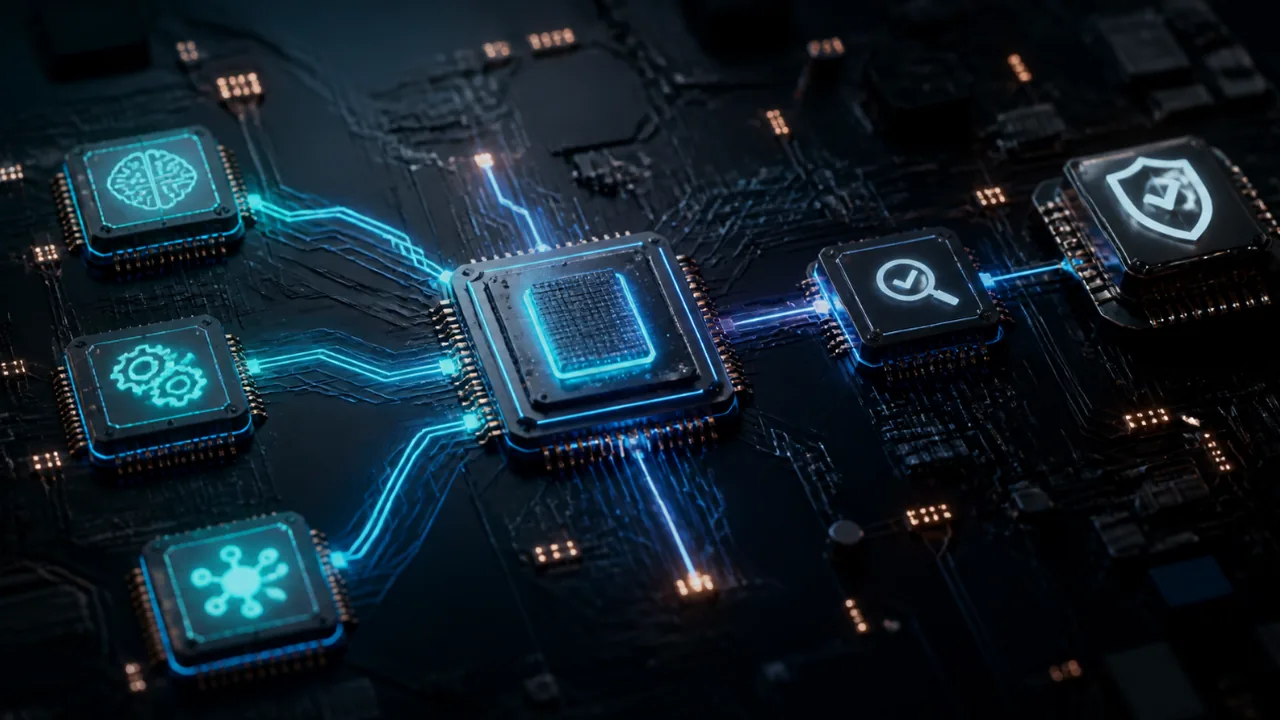
A practical architecture can be understood as six components: an intake layer that clarifies the request; an orchestrator that chooses the next step; specialist agents with narrow responsibilities; approved tools and data sources; a validator that checks outputs against explicit criteria; and a final response or action gate. Logging and policy enforcement should surround the whole flow rather than being left to the last agent.
Shared state should be deliberate. Give each agent only the context it needs, define which component may update a record, and specify how conflicting outputs are resolved. If two agents can modify the same external resource concurrently, use ordinary concurrency controls and transaction rules instead of assuming their actions will naturally stay consistent.
- Define the input and expected output before selecting an agent pattern.
- Give each specialist a narrow role and only the tools needed for that role.
- Validate intermediate outputs before passing them to later stages.
- Set maximum iterations, timeouts, token or spend budgets, and a clear stop condition.
- Record tool calls, decisions, errors, approvals and final outcomes for debugging.
Four orchestration patterns worth understanding
Sequential orchestration runs stages in a defined order. For example, one component gathers source material, another drafts a report, and a validator checks citations and required fields. This is useful when each stage depends on the previous one, but an early mistake can flow through the rest of the pipeline unless a gate catches it.
Concurrent orchestration runs independent tasks at the same time—for example, separate read-only checks for security, compatibility and documentation. It may reduce elapsed time when the tasks are genuinely independent, but it can increase peak usage and requires a rule for reconciling disagreements. Parallel agents should not all receive write access simply because they run in parallel.
Handoff orchestration transfers control to the specialist best suited to the next part of the task. It is useful when requests move between distinct domains, such as account support and technical support. Routing mistakes need a fallback, and the handoff should preserve only the context that the next specialist is authorized to see.
Manager-led or group-chat patterns allow a coordinator to assign work dynamically or agents to refine a result through discussion. These patterns can address open-ended tasks, but are harder to predict: loops, repeated work, disagreement and growing context can raise cost without improving the final answer.
| Pattern | Use when | Design for |
|---|---|---|
| Sequential | Stages have clear dependencies | Validation gates and recovery from a failed stage |
| Concurrent | Tasks are independent and parallelism has value | Conflict resolution, resource limits and safe shared state |
| Handoff | Different request types need different specialists | Routing confidence, fallback and context boundaries |
| Manager / group chat | The plan must adapt or iterative critique is valuable | Turn limits, termination criteria and auditable decisions |
A bounded example: reviewing a software change
Imagine a team wants an assistant to review a proposed code change. A safer first version can use a fixed workflow instead of allowing agents to change production systems autonomously.
The coordinator sends the same read-only change summary to separate reviewers: one checks likely security concerns, another checks test coverage, and another checks compatibility and maintainability. A synthesis step groups duplicate findings and preserves disagreements. Deterministic checks—such as the project's test suite, type checker and linter—then run in a sandbox. A final report lists evidence, unresolved questions and failed checks for a human reviewer.
This example is useful because the roles are distinct and the result can be checked. It should not be described as an autonomous self-healing pipeline: the workflow has not proven a defect, and an AI-generated patch can introduce a new one. If automatic edits are later allowed, use an isolated branch, least-privilege credentials, tests, review requirements and a rollback path. Production deployment should remain behind an explicit approval gate unless the organization has separately established safe, auditable release controls.
- Collect the change, repository rules and task scope; reject requests outside that scope.
- Run specialist reviews in read-only mode and require each finding to include a file, line or other verifiable evidence.
- Run deterministic tests and static checks in an isolated environment.
- Deduplicate findings without silently discarding conflicting assessments.
- Present evidence and uncertainty to a human reviewer; do not deploy merely because the agents agree.
Where multi-agent systems can help—and where they cannot
Potential fits include research that needs independent source gathering, software review with clearly separated criteria, support workflows spanning several systems, and analysis tasks where one component can check another against explicit requirements. The value depends on the task, the quality of tools and data, and the cost of mistakes.
More agents do not automatically mean better reasoning. Agents can share the same blind spot, repeat an incorrect claim, or produce a confident consensus without independent evidence. A validator should check outputs against facts, tests, policy or the actual environment—not simply ask another model whether the answer looks right.
Do not introduce multi-agent orchestration for a simple FAQ, a deterministic calculation, a stable rules-based approval, or a task one well-configured agent already handles reliably. A conventional program may be cheaper, faster and easier to audit. Use AI where flexible interpretation adds value; use ordinary code for exact rules and critical invariants.
Cost, latency and reliability: measure before scaling
Every additional model call can add token usage, network delay and another opportunity for an incorrect intermediate result. Parallel execution can reduce wall-clock time for independent work, but may increase peak spend. A manager that repeatedly plans and delegates can be especially difficult to budget unless the number of steps and total context are bounded.
There is no universal percentage by which multi-agent systems improve accuracy or reduce errors. Results vary with model choice, task design, evaluation method, tools and workload. Measure a representative baseline before and after adding orchestration, and include failure recovery—not just successful runs—in the comparison.
| Measure | Why it matters |
|---|---|
| Task success against a defined rubric | Tests whether the system meets the actual requirement |
| Factual or tool-result verification rate | Separates plausible text from evidence-backed output |
| End-to-end latency and per-stage latency | Shows whether parallelism or extra stages help |
| Cost per completed task | Includes all agents, retries, tools and failed runs |
| Retry, timeout and escalation rates | Reveals instability hidden by successful examples |
| Human correction or rejection rate | Shows how much review work remains |
| Permission and policy violations | Tracks failures that a simple quality score would miss |
- Compare against a simple single-agent or deterministic baseline.
- Use a representative evaluation set and keep the scoring rubric consistent.
- Track total run cost, including retries and tool execution.
- Set budgets and maximum steps before exposing the workflow to real users.
- Do not publish performance claims until the test setup and results can be reproduced.
Security and governance are architecture decisions
An agent that can read internal documents, call APIs or modify files creates a different risk profile from a chatbot that only returns text. Treat tool access as a security boundary. Apply least privilege, authenticate each action, separate read from write capabilities, and do not let an agent grant itself broader permissions.
Retrieved documents, web pages, issue comments and tool outputs must be treated as untrusted data. A malicious instruction inside a document should not override system policy or authorize a new action. Validate tool arguments and outputs, restrict network and filesystem access, and keep secrets out of prompts and logs wherever possible.
Require explicit human approval for high-impact actions such as sending external communications, changing access controls, modifying production data or deploying software. The approval should identify the exact action and target—not simply approve an open-ended plan. Keep audit records, define incident response and provide a way to stop or revoke an agent's access.
A second model reviewing the first can be useful, but it is not a security boundary by itself. Enforce critical permissions and business rules in code and infrastructure that the model cannot override.
- Use separate identities and scoped credentials for different agents and tools.
- Validate and constrain tool calls on the server side.
- Treat prompt injection and untrusted retrieved content as realistic threats.
- Add human approval for consequential or irreversible actions.
- Keep audit logs, kill switches, timeouts and a recovery plan.
A practical adoption plan
Start with a narrow, low-risk task where success can be measured. Build a simple baseline first, then add a second agent only if you can name the limitation it solves. Keep the initial pilot read-only or sandboxed, and make escalation to a human part of the workflow rather than an afterthought.
Before rollout, test ordinary inputs, ambiguous requests, conflicting agent results, missing tool data, timeouts, malformed output, malicious retrieved instructions and permission failures. Test what happens when an agent stops midway and when a later stage receives a bad result. A production design should fail closed for sensitive actions and make incomplete work visible.
Document the system's boundaries: what it may do, what it must not do, what evidence it records, who approves sensitive steps, and how operators disable it. Expand only when measured benefits persist across representative tasks and the operational burden remains acceptable.
- Write a short task contract and measurable success criteria.
- Compare a deterministic or single-agent baseline with the proposed workflow.
- Choose the least complex orchestration pattern that fits the dependencies.
- Restrict tools, data, execution time and spend; add validation at each boundary.
- Run adversarial and failure-path tests in a sandbox.
- Pilot with human review, monitor outcomes, and expand only on evidence.
The bottom line
Multi-agent orchestration is a design option, not a maturity badge. It is most defensible when specialist roles, independent work or explicit permission boundaries solve a real problem that simpler designs cannot solve as well.
For engineering teams, the best starting point is usually a small, observable workflow with bounded tools and clear human approval—not a group of autonomous agents with broad production access. Let measured results, security requirements and operational cost determine whether the architecture grows.
Architecture analysis based on the primary documentation listed below. This is not a benchmark report: no latency, cost, accuracy or productivity figures are claimed as measured by TWW.
Sources & further reading
Frequently asked questions
What is the difference between an AI agent and a multi-agent system?
An AI agent usually combines a model, instructions, context and tools to perform a task. A multi-agent system coordinates multiple agents or roles, often through an orchestrator or defined workflow.
Are multi-agent systems always more accurate than a single agent?
No. Additional agents can introduce coordination errors, duplicated work and shared blind spots. Compare them with a simple baseline using a representative evaluation set.
Which orchestration pattern should a beginner use?
Start with a fixed sequential workflow when stages are known. Use parallel execution only for independent tasks, and use dynamic delegation when the work genuinely cannot be planned in advance.
Do multi-agent systems require a vector database?
No. Storage depends on the application's retrieval, memory, state and consistency requirements. A vector database is one option for semantic retrieval, not a universal requirement for agent orchestration.
Can AI agents safely deploy code without human approval?
That depends on the risk controls and deployment environment, but a new or unvalidated system should keep deployment behind explicit approval. Use isolated execution, least privilege, tests, audit logs and a rollback plan.
We distinguish documented facts, measured results, and informed guidance. If a claim depends on a specific device, software version, game, or test method, that context should be stated rather than implied.
Meet the author·See our testing methodology·Read our editorial policy