
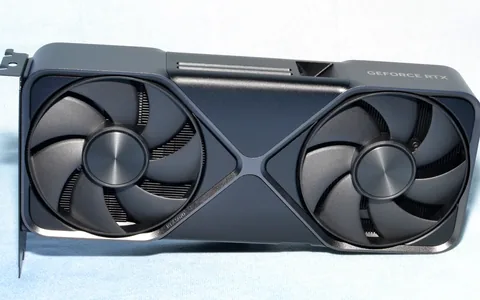
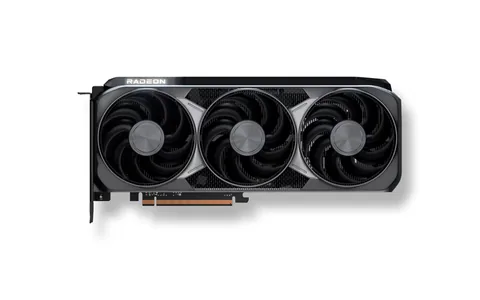
Both cards carry 16GB of video memory on a 256-bit interface. The RTX 5070 Ti uses GDDR7 and lists a 300W total graphics power, while the RX 9070 XT uses GDDR6 with a rated 640GB/s of bandwidth. The two were reviewed separately, so there is no head-to-head result to quote.
| Specification | NVIDIA GeForce RTX 5070 Ti | AMD Radeon RX 9070 XT |
|---|---|---|
| GPU architecture | NVIDIA Blackwell | AMD RDNA 4 |
| Shader hardware | 8,960 (NVIDIA specification) | 64 (AMD specification) |
| Memory | 16GB GDDR7 | 16GB GDDR6 |
| Memory interface | 256-bit | 256-bit; 640GB/s rated bandwidth |
| Clock rating | 2.45GHz (NVIDIA specification) | Up to 2.4GHz game clock / 2.97GHz boost clock (AMD ratings) |
| Power | 300W | 2 × 8-pin (AMD reference specification) |
What the specifications show
Both cards list 16GB of video memory on a 256-bit interface. The RTX 5070 Ti uses GDDR7 on NVIDIA’s Blackwell architecture, while the RX 9070 XT uses GDDR6 on AMD’s RDNA 4 architecture with a rated 640GB/s of bandwidth.
CUDA cores and AMD compute units are different building blocks, and each vendor defines its clock ratings differently. Treat the shader and clock rows as context rather than a score, because they do not predict relative game performance. The power row also mixes two kinds of figure: NVIDIA’s total graphics power rating and AMD’s reference power connectors.
What independent reviews add
Tom’s Hardware’s February 2025 review of an Asus RTX 5070 Ti Prime called it a great 1440p native card, or a 4K card with upscaling, but only an incremental upgrade over the RTX 4070 Ti Super and worth buying near the launch price. For the RX 9070 XT, Tom’s Hardware’s launch review covers rasterization, ray tracing, power, thermals and noise, and TechSpot’s August 2026 comparison tested 52 games across the RX 9070 and RX 9070 XT.
These reviews used different test benches, game lists and comparison cards, and they tested specific partner models. They are not a head-to-head between these two products, so check each review’s settings before drawing a conclusion.
How to decide
Start with the games and resolution you play, then compare current local prices and stock, since both reviewers tied their verdicts to price. Next, weigh the features you will actually use: NVIDIA’s DLSS, ray-tracing and CUDA ecosystem against AMD’s feature set. Finally, check the dimensions, cooler and power connector requirements of the exact partner card you are considering.
Frequently asked questions
Do the RTX 5070 Ti and RX 9070 XT have the same VRAM?
Both list 16GB on a 256-bit interface. The RTX 5070 Ti uses GDDR7 and the RX 9070 XT uses GDDR6.
Which is better for 1440p gaming?
Tom’s Hardware called the RTX 5070 Ti a great 1440p native card, and independent reviews found the RX 9070 XT strong for its segment. TWW has no head-to-head test, so compare the exact games you play and current local prices.
How much power does each card use?
NVIDIA lists 300W total graphics power for the RTX 5070 Ti. AMD’s reference RX 9070 XT specification lists two 8-pin power connectors. These are different kinds of figure, so check the exact partner card’s requirements.
Is this a TWW benchmark?
No. The page uses manufacturer specifications and attributed findings from outside reviewers. TWW has not tested either card.
This comparison uses manufacturer specifications and attributed outside review findings. TWW has not tested either card.
NVIDIA GeForce RTX 5070 Ti specifications and sources →