
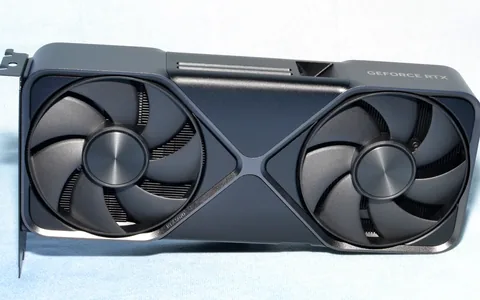
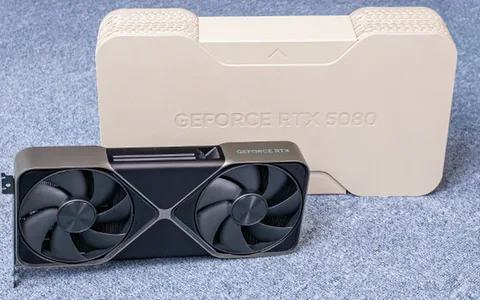
Both cards have 16GB of GDDR7 on a 256-bit interface, so the difference is mainly shader count and clocks. Tom’s Hardware estimated the RTX 5070 Ti could be up to 17% slower on paper, and possibly only 5–10% slower in memory-dependent games.
| Specification | NVIDIA GeForce RTX 5070 Ti | NVIDIA GeForce RTX 5080 Founders Edition |
|---|---|---|
| GPU architecture | NVIDIA Blackwell | NVIDIA Blackwell |
| CUDA cores | 8,960 (NVIDIA specification) | 10,752 (NVIDIA specification) |
| Memory | 16GB GDDR7 | 16GB GDDR7 |
| Memory interface | 256-bit | 256-bit |
| Boost clock | 2.45GHz (NVIDIA specification) | 2.62GHz (NVIDIA specification) |
What the specifications show
Both cards use the Blackwell architecture with 16GB of GDDR7 on a 256-bit interface, so the difference is mainly shader count and clocks: the RTX 5070 Ti lists 8,960 CUDA cores at a 2.45GHz boost clock, and the RTX 5080 lists 10,752 at 2.62GHz.
Because memory capacity and interface match, the gap between the cards is smaller than a tier jump might suggest. Specifications alone do not give a performance number.
What independent reviews add
In its RTX 5070 Ti review, Tom’s Hardware estimated that on paper the card could be up to 17% slower than the RTX 5080, and possibly only 5–10% slower in memory-dependent games. That is a reviewer’s estimate, not a measured head-to-head in this comparison.
Tom’s Hardware tested an Asus RTX 5070 Ti Prime and an RTX 5080 Founders Edition, which are different cards from different reviews, so use each review’s own game list and settings.
How to decide
Compare the exact games and resolution you play, then weigh current local prices, the specific partner card’s cooling and size, and your power supply. If the price gap in your market is large and you play at 1440p, the smaller performance gap may matter more than the tier name.
Frequently asked questions
Do the RTX 5070 Ti and RTX 5080 have the same VRAM?
Yes. Both list 16GB of GDDR7 on a 256-bit interface.
How many CUDA cores does each card have?
The RTX 5070 Ti lists 8,960 CUDA cores at a 2.45GHz boost clock, and the RTX 5080 lists 10,752 at 2.62GHz.
How much slower is the RTX 5070 Ti?
Tom’s Hardware estimated up to 17% on paper and possibly 5–10% in memory-dependent games. That is a reviewer’s estimate, not a measured head-to-head or a TWW result.
This comparison uses manufacturer specifications and attributed outside review findings. TWW has not tested either card.
NVIDIA GeForce RTX 5070 Ti specifications and sources →
NVIDIA GeForce RTX 5080 Founders Edition specifications and sources →